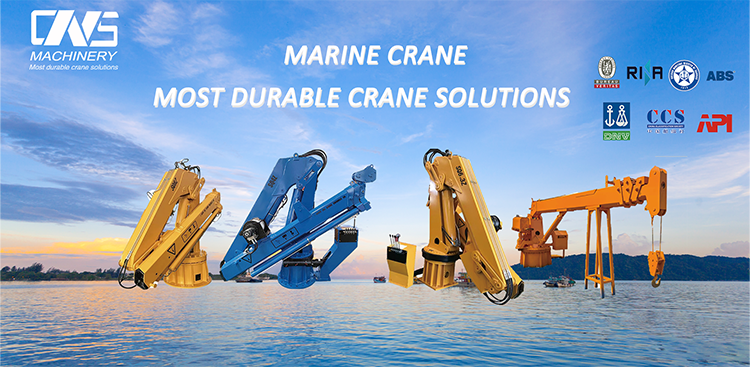
Deck crane
Folding, fixed and rotating crane
This type of crane is the most widely used and can operate independently or in pairs on both starboard and starboard sides.
The lifting capacity is generally 3 to 5 tons. On multi-purpose ships, it is required that a single crane can lift a 20-foot container, and a double crane can lift a 40-foot container (30 tons), with a lifting capacity of 25 to 30 tons.
2. Folding, moving and rotating crane
When loading and unloading goods requires a large span of the crane but it is desired that the crane boom is not too long, a mobile rotating crane is often adopted.
There are two types of mobile rotating cranes: lateral movement along the ship and longitudinal movement.
Marine crane
Folding gantry crane
This type of crane is widely adopted by full container ships (see container ships) and barges, and is usually quadruped or C-shaped.
There is an extendable boom, a crossbar for lifting weight, a movable bridge frame and a cab.
The horizontal main beam of the bridge frame is higher than the containers stacked on the deck and is equipped with an automatic positioning device, allowing the containers to be accurately placed in the container compartments or stacked on the deck during loading.
The number of gantry cranes on barge carriers is greater than that on container ships, and the lifting capacity can reach several hundred tons.
2. Fold other loading and unloading machinery
The main ones are elevators, hoists and conveyors.
The lift is a mechanical device that moves vertically along the guide rails on a ship and is used to lift and lower goods between different decks.
For example, on roll-on/roll-off ships, elevators are often used to connect each deck for transporting goods. There are several types of elevators on roll-on/roll-off ships, such as scissor type and chain type. Their lengths range from 9 to 18.5 meters and their widths from 3 to 5 meters.
Some barges are also equipped with elevators for loading and unloading cargo barges, but their lifting capacity is much greater than that on roll-on/roll-off ships.
A hoist is used to continuously convey goods in the vertical direction or a relatively large inclined direction.
A conveyor is used to continuously transport goods in a horizontal direction or a direction with a gentle slope. These two types of machinery are mostly used on dump ships or on ships where loading and unloading are carried out through the hull door.